
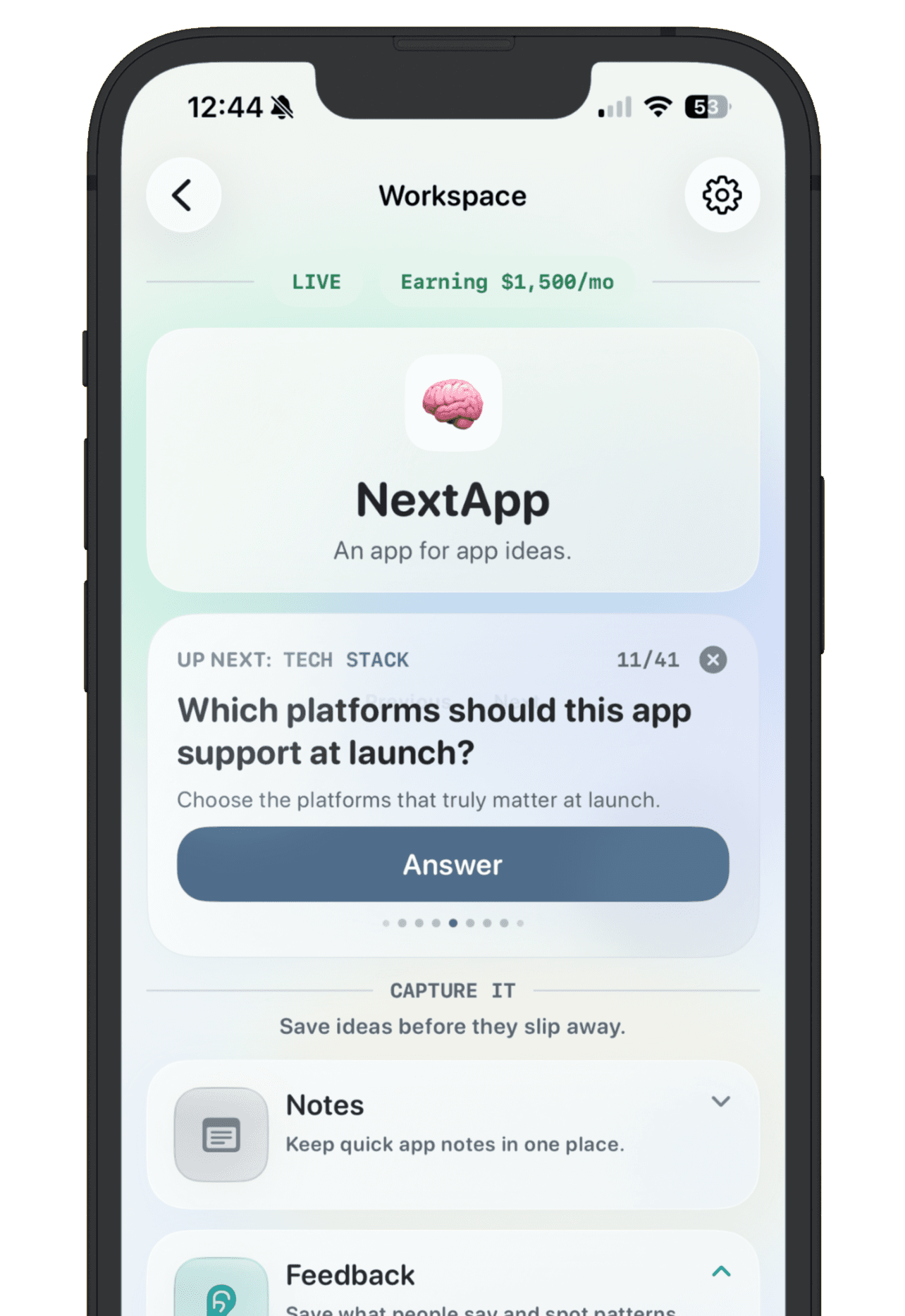
Notion is flexible enough to track almost anything, which is exactly why many app idea systems start there. A database, a few statuses, a template, and suddenly your backlog looks real. The problem usually appears later: every app idea needs notes, feedback, goals, links, launch status, and sometimes a public page, but a generic database does not know which pieces belong together.
A good Notion alternative for app ideas should not be less organized. It should be more specific. It should make the app idea the center of the system, then keep the messy supporting pieces attached to that app instead of spread across pages, boards, and pasted links.
When Notion works well
Notion is a strong choice when you want total flexibility, team documentation, or a custom database that can become anything. If your app ideas are still simple notes and you enjoy designing your own workflow, a Notion template may be enough.
Where a generic database gets heavy
The friction starts when every idea needs its own mini operating system. You add user context, promise, status, revenue goal, feedback, app link, support link, launch notes, screenshots, and public updates. Then you add views. Then you adjust the template. Eventually the system starts asking for more maintenance than the ideas themselves.
What a dedicated tracker should handle
An app idea tracker should have first-class places for the things app builders repeatedly need: quick capture, one workspace per app, focused notes, goals, feedback, live links, revenue or user targets, launch context, and a public maker page when the app becomes real.
Private planning and public proof should be separate
A Notion page can be public, but public sharing often exposes the wrong shape of the work. Builders usually need private notes for messy thinking and a cleaner public surface for apps that are ready to show. Those are different jobs.
Use this decision rule
Stay in Notion if you mostly want a flexible idea database. Move to a dedicated tracker when you want the product record, feedback, goals, launch links, and public app page to stay connected without building that structure yourself.
A quick comparison
- Notion is best for custom databases and documentation
- Spreadsheets are best for quick comparison rows
- Task boards are best for execution steps
- NextApp is built around the app idea itself: capture, plan, track feedback, set goals, and share the apps that ship
NextApp is not trying to replace every workspace. It is meant to replace the fragile app idea setup that starts as a Notion database and slowly becomes too generic for real app-building decisions.