
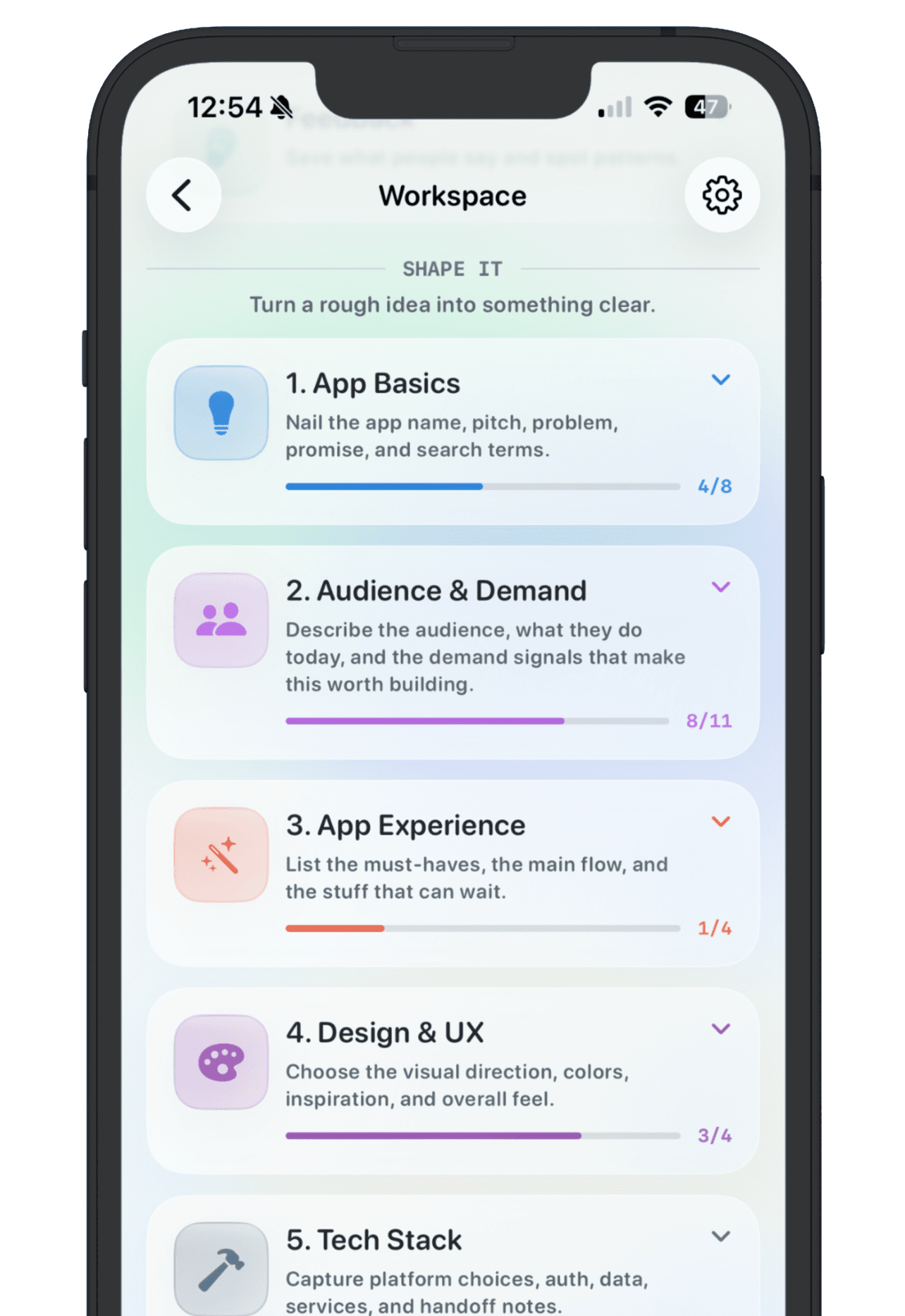
An MVP scope planner helps you decide what the first version of an app should prove. It is not a place to store every feature you hope to build someday. It is a filter that protects the smallest useful version from the full dream roadmap.
For indie builders, scope is usually the difference between shipping and quietly drifting. A clear MVP can be built, tested, and improved. A vague MVP becomes a long list of features that delays the first real signal.
Start with the riskiest promise
Write the app promise in one sentence, then ask what would make that promise false. If the promise is about helping builders organize app ideas, the risk may be whether capture is fast enough, whether ideas are easy to compare, or whether feedback can stay attached to the right app. The MVP should test the riskiest part first.
Name the first user
Do not scope the first version for every possible user. Scope it for the first specific user who would recognize the problem. A solo iOS developer, a vibe coder with several prototypes, or an indie founder preparing a launch may need different first versions. The MVP gets sharper when the user is real.
Split must-have from later
Must-have features are the pieces required to deliver the first promise. Later features are useful but not required to learn. Be strict. If a feature does not help the first user complete the main job or help you validate the main risk, it belongs in later.
Write the first workflow
Describe the smallest workflow from start to finish. For an app idea tracker, that might be: capture an idea, add a promise, set a status, attach one note, and review the idea later. If the workflow cannot be written in a few steps, the scope is probably still too wide.
Choose one success signal
Pick one signal before building: a user saves five ideas, a beta tester returns after a week, someone shares a public app page, a first customer pays, or three people ask for the same improvement. The signal tells you whether to continue, narrow, or pause.
Keep the roadmap nearby but separate
Future ideas are not bad. They just should not sneak into the MVP. Keep roadmap notes attached to the app idea, but label them as later. This lets you preserve good thinking without letting it expand the first version.
A simple MVP scope template
- First user
- One-sentence promise
- Riskiest assumption
- First workflow
- Must-have features
- Later features
- Validation signal
- Launch or test link
NextApp helps keep MVP scope grounded because the idea, notes, goals, feedback, and launch status stay in one app workspace. The first version can stay small while the bigger product thinking remains organized for later.