
An AI app idea generator can give you a long list of possible apps in seconds. That is useful, but it is also dangerous. The faster ideas appear, the easier it is to confuse quantity with signal.
Generated app ideas need a second system: a place to save the promising ones, score them against real criteria, attach evidence, and decide what deserves a prototype. The generator creates sparks. The tracker keeps the sparks from becoming noise.
Use generators for breadth
Generators are good for exploring categories, audiences, niches, and starting points you might not have considered. They can help you turn a vague interest into ten possible app directions, or remix one idea into different audiences and feature sets.
The output should stay rough. Treat generated ideas as candidates, not instructions. If an idea sounds exciting, save the original prompt, the generated description, and the reason it caught your attention before you start editing it into something else.
Use a tracker for judgment
A tracker is where generated ideas become comparable. The useful question is not which generated paragraph sounds best. It is which idea has a clear user, a real problem, a small first version, evidence, risk you can test, and a next decision.
- Who is the first user?
- What problem already happens without the app?
- What is the smallest useful version?
- Where could you get feedback?
- What evidence would make the idea worth building?
- What would make you archive it?
Validate before you vibe-code
AI app builders make it tempting to generate the app immediately. For some ideas, that is fine. But if you have ten generated concepts, pick one validation action before opening Lovable, Bolt, Replit, v0, Cursor, or Claude Code. Search for existing tools, ask three likely users, write the one-sentence promise, or mock the main workflow.
The goal is not to slow down. It is to stop weak ideas from becoming polished prototypes that still have no user, no feedback path, and no reason to continue.
Keep generated ideas separate from active builds
Generated ideas belong in an idea backlog until they collect evidence. Active builds need a richer record because they are no longer just concepts: they have a current link, product history, feedback, goals, status, and launch context. Mixing raw generated ideas with real builds makes the whole workspace harder to trust.
Archive aggressively
Most generated ideas should not be built. Archive ideas with no clear user, no reachable feedback path, or no small first version. Archiving is not failure. It is how you keep the active list honest enough to use.
Where NextApp fits
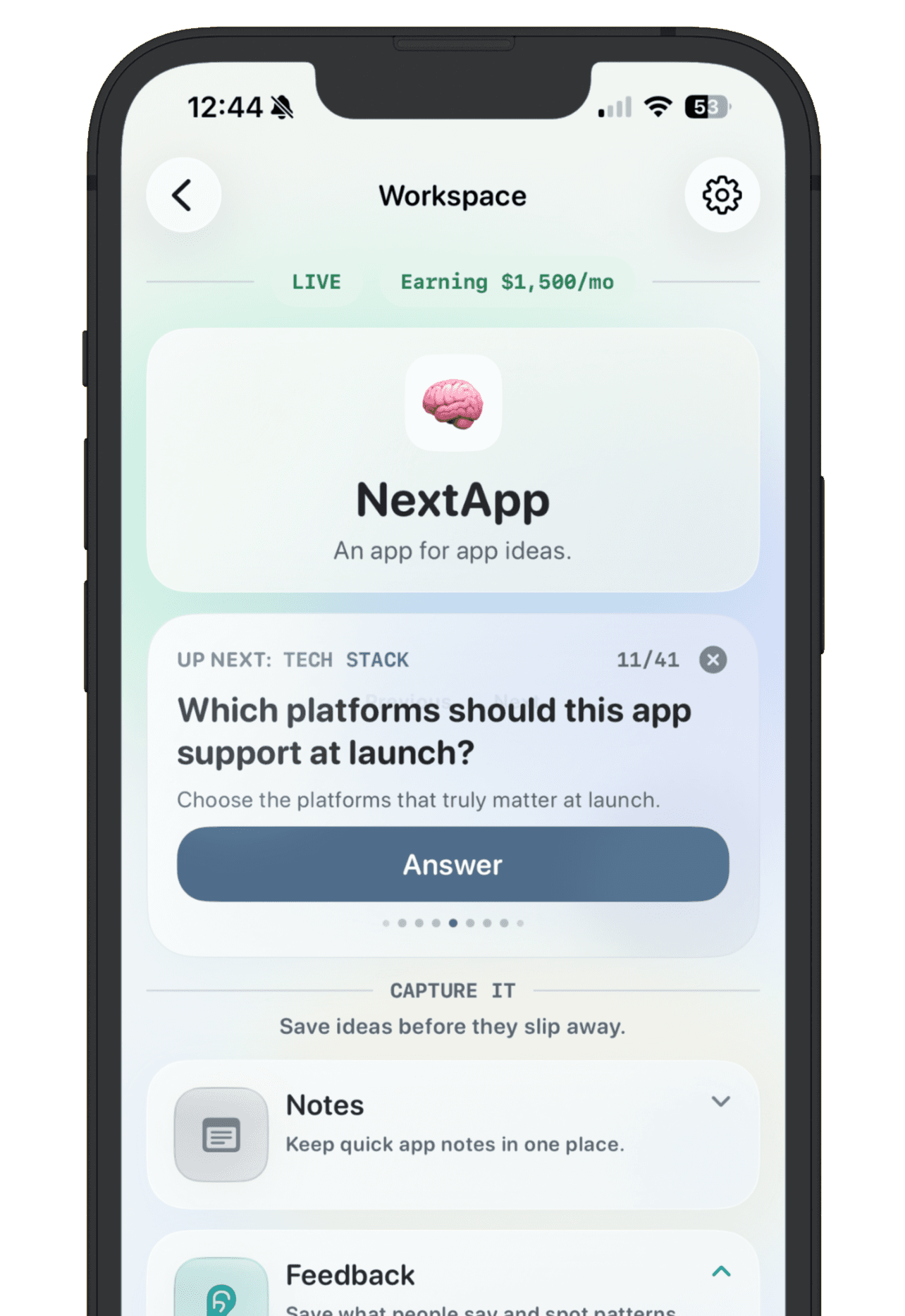
NextApp is the tracker after the generator. Use any AI app idea generator for inspiration, then use NextApp to save the ideas worth remembering, compare them, attach evidence, track AI-built prototypes, and publish the apps that become real.
The best workflow is simple: generate broadly, track carefully, validate lightly, build narrowly, and keep the next decision visible.