
Most app ideas do not disappear because they were bad. They disappear because they were captured in the wrong place: one note in Apple Notes, a screenshot in Photos, a voice memo, a half-finished GitHub repo, and a message to yourself with no context. The goal is not to create more admin work. The goal is to make every promising idea easy to find, compare, and revisit.
A useful app idea system has four jobs: capture the spark, preserve the reason it mattered, show what stage the idea is in, and make the next decision obvious. If a system cannot do those four things quickly, builders stop using it.
Start with one record per app idea
Do not keep every app idea in one giant note. Give each idea its own home with the working name, the person it helps, the current state, and the moment that made it feel worth saving. The separation matters because app ideas collect different evidence over time. One idea may need customer feedback. Another may need pricing research. Another may just need a weekend prototype.
A dedicated record also protects the original thought. When you come back weeks later, you should be able to remember why the app felt worth building before your later edits made it more polished.
Use statuses that match real builder decisions
Simple statuses are better than a complicated workflow. Start with Inbox, Researching, Building, Live, Paused, and Archived. Inbox is for raw sparks. Researching means the idea needs proof. Building means you have committed time. Live means people can use it. Paused means it is not dead, but it is not active. Archived means you made a decision and can stop carrying it mentally.
The point of status is not project management theater. It is to see which ideas are still only thoughts, which ones have evidence, and which ones deserve a next action.
Attach evidence where it belongs
Feedback, screenshots, links, pricing notes, and launch ideas should live with the exact app idea they describe. If feedback sits in a chat thread, it becomes hard to compare later. If a pricing note sits in a random spreadsheet, it gets disconnected from the product decision. Evidence is only useful when it is attached to the idea it changes.
Keep the comparison surface small
You do not need a giant intake form for every idea. Save the small set of facts that help you decide what to build next: who it is for, what problem it solves, why now, what proof exists, what the first version would include, and what goal would make it worth continuing.
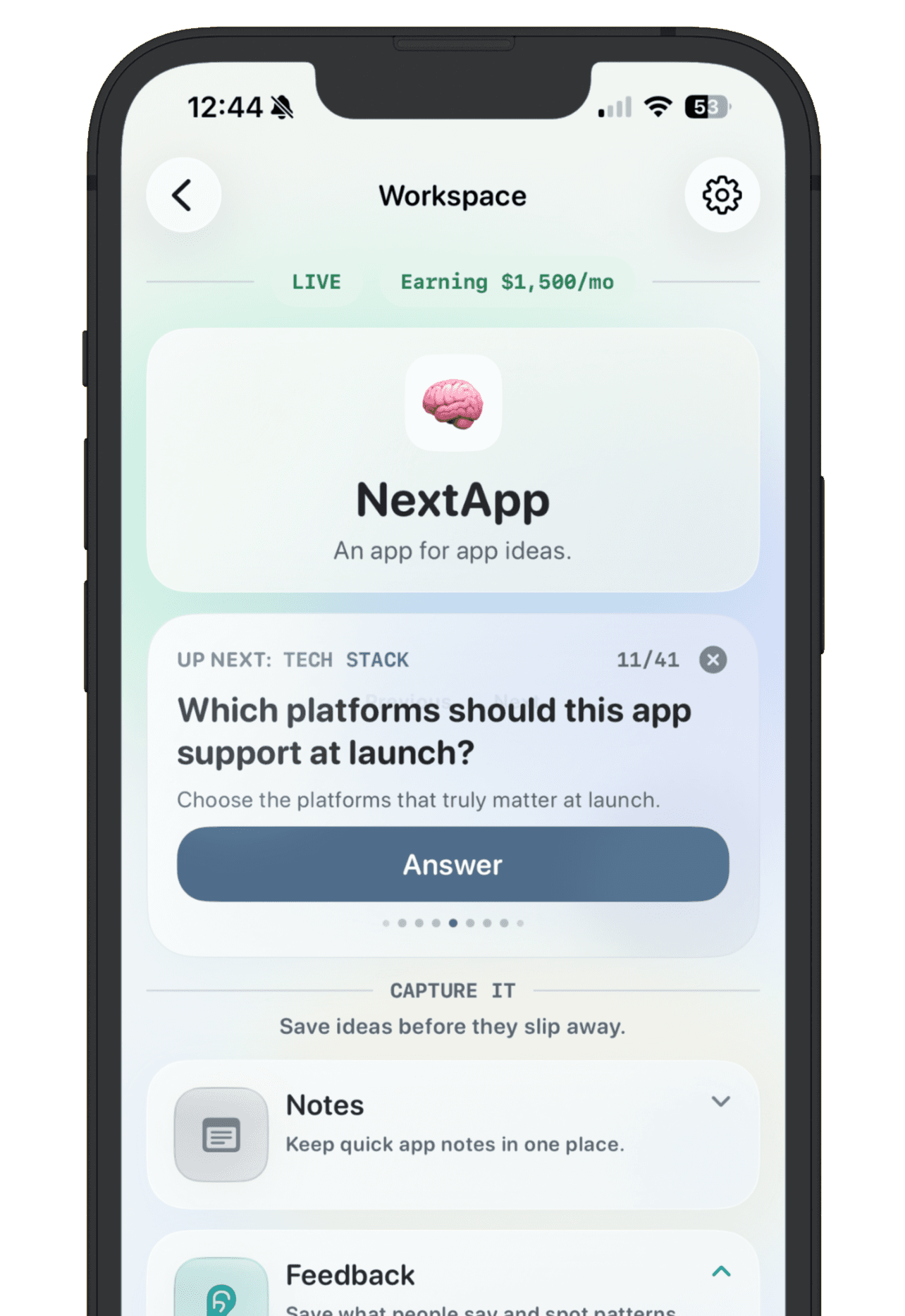
NextApp is built around that shape: one workspace per app, quick capture for loose ideas, goal tracking for promising ones, feedback logs, and public maker pages when an app becomes real. The structure is specific enough to help but light enough to keep using.
Review ideas on a cadence
A backlog only works if it gets reviewed. Once a week, scan the ideas by status. Move weak ideas to Archived. Promote ideas that collected real signal. Add one next action to the ideas that are still alive. The review should take minutes, not hours.
The best app idea organizer is not the one with the most knobs. It is the one that helps you see your options clearly when you finally have time to build.